Quick Answer
Yes, a quality foldable mobility scooter can comfortably handle a full day at most airports. In fact, many travelers cover between 2 and 6 miles during a typical travel day, including time spent moving through parking areas, security checkpoints, terminals, restaurants, baggage claim zones, and transportation hubs. Therefore, a foldable mobility scooter with a real-world battery range of 10–18 miles is usually more than capable of meeting airport travel demands.
Why This Matters
Airport travel has become increasingly demanding, particularly for seniors and individuals with limited mobility. Although many airports provide wheelchair assistance, travelers often face long wait times, gate changes, crowded terminals, and extended walking distances.
Furthermore, modern airports continue to expand. What once required a short walk may now involve navigating multiple terminals, transportation trains, long security lines, and sprawling concourses. Consequently, even travelers with mild mobility limitations can find the experience exhausting.
Understanding Real Airport Walking Distances
Many travelers underestimate how much ground they cover during a typical trip.
Consider a standard domestic flight.
Typical Domestic Airport Travel Day
| Activity | Approximate Distance |
|---|---|
| Parking area to terminal | 0.25–0.75 miles |
| Check-in and security | 0.25–0.5 miles |
| Security to departure gate | 0.5–1 mile |
| Food, restroom, and shopping visits | 0.25–0.5 miles |
| Gate changes | 0.25–0.75 miles |
| Arrival terminal navigation | 0.5 miles |
| Baggage claim to transportation | 0.25–0.5 miles |
Large International Airports
The situation becomes even more demanding at major international airports.
For example, airports such as:
- Atlanta Hartsfield-Jackson
- London Heathrow
- Dallas/Fort Worth
- Toronto Pearson
- Sydney Airport
- Los Angeles International
often require travelers to move between terminals, customs checkpoints, transportation systems, and baggage claim areas.
As a result, daily travel distances can easily reach 4–6 miles or more.
Fortunately, most modern travel scooters offer sufficient battery capacity to handle these distances comfortably.
Real-World Scenario: A Full Travel Day
Imagine a 72-year-old traveler flying from Chicago to Orlando for a cruise vacation.
The journey begins with navigating the airport parking garage. After reaching the terminal, the traveler proceeds through check-in and security before heading to a departure gate located nearly a mile away.
Later, a gate change requires additional travel across the terminal. Upon arrival in Orlando, the traveler must navigate baggage claim, transportation pickup areas, and the cruise terminal.
Meanwhile, the scooter must fit into a shuttle vehicle and later store easily inside a cruise cabin.
In this situation, portability becomes just as important as battery range.
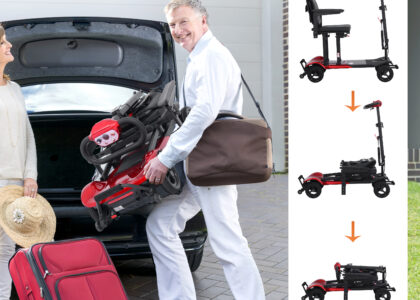
A large traditional scooter may offer excellent comfort. However, loading it into vehicles and storing it during the trip could be difficult. Conversely, a lightweight foldable scooter may provide enough range while simplifying transportation and storage throughout the journey.
Storage Challenges Travelers Often Overlook
Battery range receives most of the attention during the buying process. Nevertheless, storage requirements frequently become the deciding factor after purchase.
A scooter may perform perfectly at the airport. However, problems can arise once travelers reach their destination.
Common storage locations include:
- Hotel rooms
- Cruise cabins
- Apartment closets
- RV storage compartments
- Vehicle trunks
- Assisted living residences
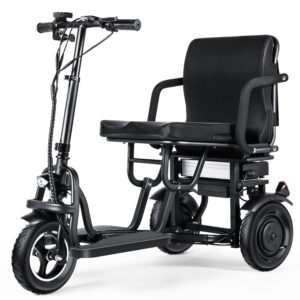
Traditional mobility scooters typically require more storage space. In contrast, foldable mobility scooters collapse into a compact footprint that can fit in areas where larger scooters simply cannot.
Consequently, travelers who frequently fly, cruise, or take road trips often prioritize folding designs.
Transportation Concerns Before Buying
Transportation is another factor that buyers frequently underestimate.
Before purchasing a mobility scooter, ask yourself several practical questions.
Can You Lift the Scooter?
Some travel scooters weigh approximately 35 pounds, while others exceed 60 pounds.
Although the difference may seem small on paper, it becomes significant when lifting the scooter into a vehicle after a long day of travel.
Do You Travel Independently?
Travelers who frequently travel alone often prioritize:
- Lightweight construction
- Quick folding mechanisms
- Compact dimensions
- Easy vehicle loading
On the other hand, individuals who travel with caregivers may have more flexibility when choosing heavier models.
What Type of Vehicle Do You Use?
Storage capacity varies considerably between:
- Sedans
- Compact SUVs
- Full-size SUVs
- Pickup trucks
- RVs
Therefore, measuring available cargo space before purchasing a scooter is highly recommended.
Key Features That Matter Most
1. Weight
Weight directly affects portability.
Generally speaking, lighter scooters are easier to:
- Lift
- Fold
- Transport
- Store
However, lighter designs sometimes sacrifice comfort and battery capacity.
For frequent travelers, a scooter weighing under 50 pounds is often easier to manage.
2. Battery Range
Manufacturers typically advertise maximum range under ideal conditions.
However, real-world range depends on:
- Rider weight
- Terrain
- Speed settings
- Temperature
- Cargo load
For airport travel, experts generally recommend choosing a scooter capable of delivering at least 10 miles of realistic range.
This provides a comfortable safety margin for delays and unexpected detours.
3. Maximum Speed
Most travel mobility scooters operate between:
- 3.7 mph
- 5 mph
- 7 mph
Although higher speeds may sound appealing, maneuverability and safety are usually more important inside crowded airports.
Therefore, a moderate top speed is often sufficient.
4. Weight Capacity
Weight capacity influences both performance and durability.
Common ratings include:
- 220 lbs
- 265 lbs
- 300 lbs
- 350 lbs
Always account for:
- Personal weight
- Carry-on luggage
- Shopping bags
- Medical equipment
when evaluating capacity requirements.
5. Folding Time
Frequent travelers quickly appreciate a simple folding system.
The best travel scooters fold in just a few seconds.
Consequently, users spend less time struggling with equipment and more time focusing on their trip.
6. Climbing Ability
Although airports appear relatively flat, small inclines are common.
Examples include:
- Parking garage ramps
- Sidewalk transitions
- Boarding areas
- Terminal entrances
A scooter capable of handling moderate inclines generally performs better in real-world situations.
7. Portability
Portability involves more than overall weight.
Buyers should also consider:
- Folded dimensions
- Carry handles
- Transport wheels
- Ease of maneuvering when folded
These factors significantly influence the travel experience.
8. Storage Requirements
Storage space matters every day, not just during travel.
Before purchasing, identify where the scooter will spend most of its time.
For example, apartment residents often prioritize compact storage, while homeowners with garages may have more flexibility.
Comparison Table
| Feature | TopMate ES15 | Pride Go-Go Folding Scooter | EV Rider Transport AF+ | Traditional 4-Wheel Scooter |
| Approximate Weight | ~35 lbs | ~51 lbs | ~49 lbs | 90–150+ lbs |
| Range | Up to 18 miles | Up to 9–13 miles | Up to 10–15 miles | 15–25+ miles |
| Maximum Speed | Up to 4.97 mph | Around 4 mph | Around 4 mph | 4–8 mph |
| Portability | Excellent | Very Good | Very Good | Limited |
| Storage Ease | Excellent | Good | Good | Poor |
| Vehicle Loading | Easy | Moderate | Moderate | Difficult |
| Ride Comfort | Moderate | Good | Good | Excellent |
| Airport Suitability | Excellent | Very Good | Very Good | Good |
| Cruise Travel | Excellent | Good | Good | Limited |
| Best Use Case | Frequent travelers | Mixed travel and daily use | Travelers wanting automatic folding | Daily local mobility |
Pros and Cons
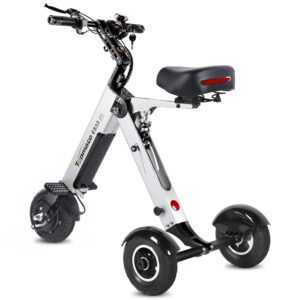
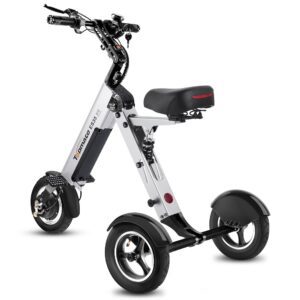
TopMate ES15
Pros
- Lightweight and highly portable
- Compact folded size
- Easy to store in vehicles
- Suitable for airports and cruise travel
- Good balance between range and portability
Cons
- Smaller seating area
- Limited suspension compared with larger scooters
- Less suitable for rough outdoor terrain
Real-Life Buying Considerations
Airport Travel
For airport use, prioritize:
- Airline-approved batteries
- Compact folded dimensions
- Lightweight construction
- Easy maneuverability
As a result, most frequent flyers gravitate toward foldable models.
Cruise Travel
Cruise cabins often have limited floor space.
Therefore, a compact scooter can make daily life onboard significantly easier.
Additionally, narrow hallways and elevators are easier to navigate with smaller mobility devices.
Apartment Storage
Apartment dwellers should carefully evaluate:
- Closet dimensions
- Elevator access
- Hallway widths
- Entry door measurements
Even a few inches can make a substantial difference in usability.
Vehicle Transportation
Vehicle compatibility remains one of the most overlooked buying considerations.
Before making a purchase, verify:
- Cargo opening dimensions
- Lift height requirements
- Available storage space
- Loading assistance availability
Shopping Trips
A mobility scooter should support more than travel.
Many owners also use their scooter for:
- Grocery shopping
- Retail stores
- Medical appointments
- Community events
Consequently, maneuverability and battery reliability become everyday priorities.
Outdoor Riding
Parks, tourist attractions, and waterfront areas present unique challenges.
Although travel scooters can handle paved surfaces effectively, larger scooters generally offer greater comfort for extended outdoor use.
Therefore, buyers who spend substantial time outdoors may prefer a more robust model.
Expert Buying Framework
Before making a decision, answer these five questions.
How Often Do You Travel?
- Monthly travel: prioritize portability
- Occasional travel: balance comfort and portability
- Rare travel: prioritize comfort
Will You Load It Yourself?
- Yes: choose a lighter scooter
- No: consider larger models
Where Will It Be Stored?
- Apartment
- RV
- Cruise cabin
- Garage
- Vehicle trunk
Storage limitations often influence the best choice.
How Long Are Your Typical Rides?
- Under 3 miles: travel scooter
- 3–8 miles: versatile folding scooter
- Over 8 miles regularly: larger mobility scooter
What Is Your Main Use Case?
- Airports
- Cruises
- Shopping
- Daily transportation
- Outdoor recreation
The answer should guide your final decision.
Final Recommendation
For most travelers, a foldable mobility scooter can easily handle a full day at the airport. Not only do modern travel scooters provide sufficient battery range for typical airport distances, but they also simplify transportation, storage, and vehicle loading.
Nevertheless, portability should not be the only factor influencing your decision. Comfort, stability, storage requirements, and everyday riding habits deserve equal consideration. Travelers who frequently fly, cruise, or take road trips will likely benefit most from compact models such as the TopMate ES15, Pride Go-Go Folding Scooter, or EV Rider Transport AF+. Meanwhile, users who prioritize daily comfort and rarely transport their scooter may be better served by a traditional 4-wheel mobility scooter.
FAQ
Can a foldable mobility scooter handle a full day at the airport?
Yes. Most foldable mobility scooters offer enough battery range to cover the 2–6 miles many travelers encounter during a typical airport travel day.
What battery range is best for airport mobility scooter travel?
A scooter with a real-world range of at least 10 miles is generally recommended to accommodate airport terminals, delays, layovers, and transportation areas.
Are foldable mobility scooters allowed on airplanes?
Most airlines allow mobility scooters with approved battery types, but travelers should always check airline battery and mobility device policies before flying.
Is a foldable mobility scooter better than a traditional 4-wheel scooter for travel?
For frequent travelers, foldable scooters are usually easier to transport and store. However, traditional 4-wheel scooters often provide greater comfort and stability for daily use.

-scaled-2-420x300.jpg)